The Gap in Klaviyo’s Abandoned Cart Recovery for Shopify Stores
You've set up your Klaviyo abandoned cart flow. Three emails, perfectly timed. Subject lines A/B tested. A discount code in email three. You've done everything right.
And you're still watching a large share of your carts walk out the door.
This isn't a dig at Klaviyo. For Shopify stores, it is one of the strongest email platforms available. But there's a structural gap in what Klaviyo can do - and understanding it is worth thousands of pounds in recovered revenue every month.
The issue is that email recovery has three built-in limits: timing, interactivity, and identity capture. That’s why many stores recover some abandoned carts with Klaviyo and still leave a large share unrecovered.
Here's what that gap is, why it exists, and what fills it.
The 70% Problem Isn't Going Away
Cart abandonment is the most persistent problem in ecommerce. According to the Baymard Institute, the average cart abandonment rate across all online retail is 70.19%. For every ten shoppers who add something to their cart, seven leave without buying.
Baymard estimates that $260 billion in lost orders is recoverable in the US and EU through better recovery strategies - not by fixing checkout friction alone, but by engaging abandoners at the right moment, in the right channel, with the right message.
The right moment matters more than most merchants realise. Research consistently shows that purchase intent drops sharply with time. The window where a shopper can be recovered - sometimes called the Golden Hour as borrowed from the ER - is roughly the first 15 to 30 minutes after they abandon, when purchase intent is still fresh. After that, attention moves on, the emotional pull of the product fades, and recovery rates drop significantly.
Many Klaviyo abandoned cart flows are configured to send the first email around an hour after abandonment.
That's already outside the Golden Hour.
What Klaviyo Does Well
Before getting into the gap, it's worth being clear about what Klaviyo genuinely excels at.
Klaviyo is a sophisticated marketing automation platform with deep Shopify integration. Its abandoned cart flows are among the best-performing in email marketing - Klaviyo's own benchmark data shows abandoned cart emails outperform almost every other email marketing campaign type in open rates and revenue per recipient.
For Shopify stores, Klaviyo offers:
Automated multi-step abandoned cart email sequences
Deep segmentation by cart value, product type, and customer history
Personalised product imagery pulled directly from Shopify
A/B testing on subject lines, timing, and content
Accurate revenue attribution
If you're not running a Klaviyo abandoned cart flow, start one today. It will recover some of your lost carts and it costs relatively little to run.
But "some" is not "most." And the gap between what Klaviyo recovers and what's actually recoverable is where the real money is.
The Three Limits of Email-Only Cart Recovery
1. Email is a scheduled channel, not a real-time one
Klaviyo sends emails. Emails sit in overcrowded inboxes. Inboxes get checked - eventually. Promotion emails get checked - very irregularly.
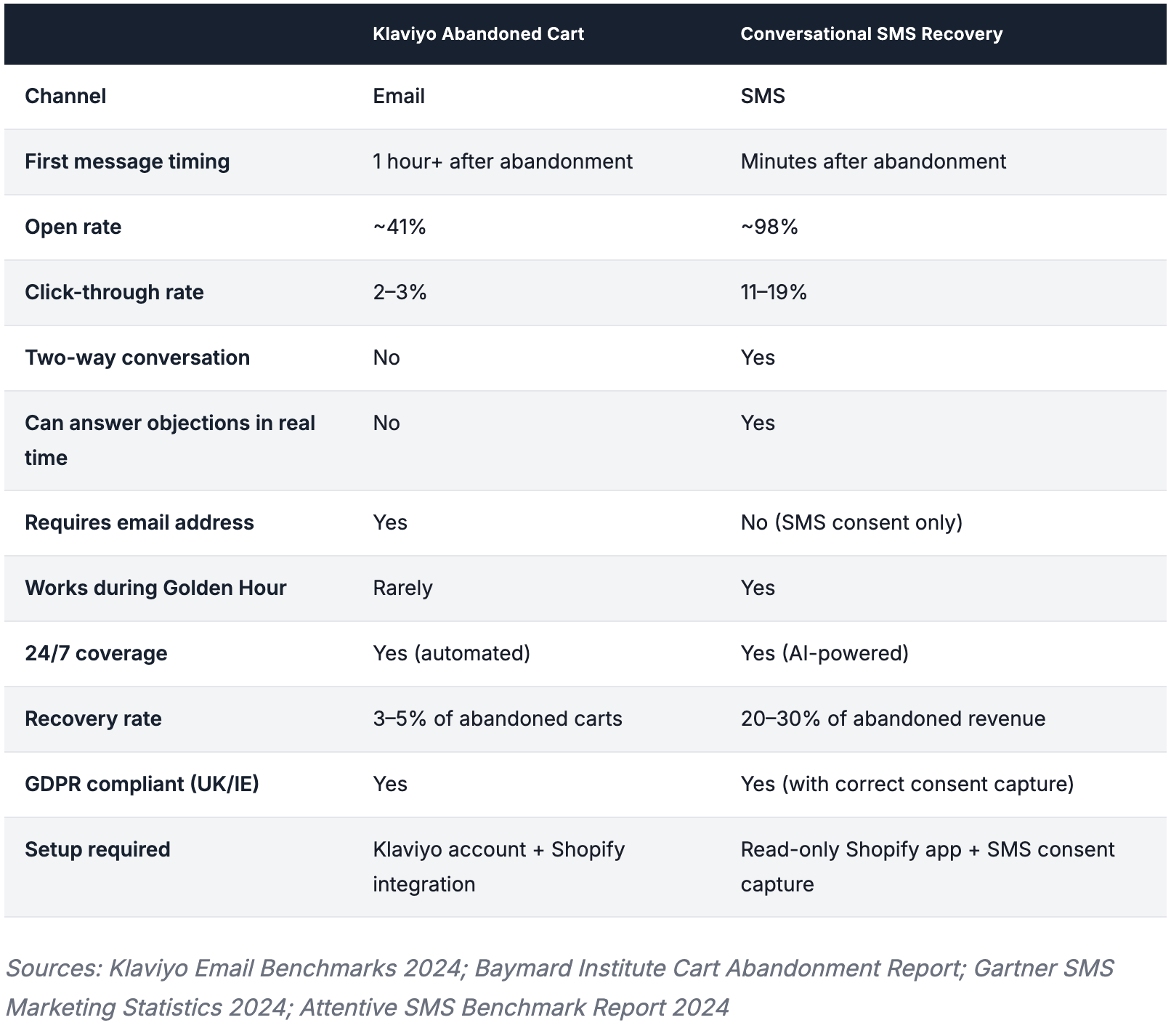
The average email open rate for abandoned cart campaigns is 41% according to Klaviyo's own benchmark data. That means 59% of your abandoned cart emails are never even opened. Of those that are opened, average click-through rates sit at 2–3%.
Think about what that means in practice. If 1,000 shoppers abandon their carts this month, roughly 590 will never open your first recovery email. Of the 410 who do, only 20–30 will click through. You've already lost the vast majority before a single conversation has started.
By contrast, SMS is generally opened far more often than email and tends to be read quickly after receipt. It meets shoppers where they actually are - on their phone, in the moment - rather than in an inbox they check once a day.
2. Email can't answer questions
Here's the most common reason shoppers abandon carts, according to Baymard Institute research:
Unexpected shipping costs (39% of abandonments)
Having to create an account (24%)
Delivery too slow (21%)
Didn't trust the site with card details (18%)
Complicated checkout process (17%)
Notice something? Most of these are questions or objections, not just reminders to come back. The shopper wanted to buy but something stopped them. They needed an answer - about shipping cost, delivery time, returns policy, whether the item comes in their size, how fresh the food is, how long they're committed to a subscription - and they couldn't get it quickly enough so they left.
A Klaviyo email cannot answer a question in real time. It can include your FAQ, a link to your returns page, a reassurance about delivery. But if the shopper replies to that email asking "does this come in a size 12?" - nothing happens. The conversation ends.
Conversational SMS opens a two-way channel. When a shopper gets a message that says "I saw you were interested in the sapphire satin dress - can I help?" and they reply "Not sure about the return policy", the AI can answer that question immediately, in natural language, and guide them back to checkout. That's the difference between a broadcast and a conversation.
3. Email recovery depends on email capture. SMS recovery depends on mobile consent.
Klaviyo's abandoned cart flow only triggers if you have the shopper's email address. If they browsed, added to cart, and left without entering their email at checkout - Klaviyo never knew they were there.
With SMS cart recovery, consent is captured at the point of SMS opt-in - often earlier in the customer journey, via a popup or checkout opt-in. This means you can recover carts from shoppers who never reached the email capture stage of checkout, expanding your recoverable audience significantly.
Klaviyo Abandoned Cart vs Conversational SMS: Side by Side
The Maths: What the Gap Costs a £500k Shopify Store
Let's make this concrete.
If a Shopify store turns over £500k in annual revenue after 70% cart abandonment, the total value of carts started over the year would be about £1.67m, with roughly £1.17m abandoned before purchase.
If an existing Klaviyo flow recovers 4% of that abandoned value, that would return about £46.7k.
If conversational SMS then recovered a further 25% of total abandoned cart value on an incremental basis, that would add roughly £291.7k in recovered revenue before fees.
And because Cart Rescue AI operates on a 15% commission on recovered revenue only, that £291.7k in additional recovery costs £43.7k in fees. Net gain: £248k.
If we recover nothing, you pay nothing. The model only works if the results do.
This Is Not an Either/Or Decision
The most important thing to understand is that Klaviyo and conversational SMS are not competing solutions. They occupy different parts of the recovery window.
Klaviyo handles the longer tail - shoppers who open emails hours or days later, browse, consider, and eventually return. It's excellent for that. Keep it running.
Conversational SMS handles the Golden Hour - the critical first 15–30 minutes when purchase intent is highest, objections are live, and a single answered question can turn an abandoned cart into a completed order.
Running both gives you the most complete recovery coverage possible. Most of our clients already have Klaviyo running when they come to us. We don't ask them to turn it off.
What GDPR-Compliant SMS Recovery Looks Like for UK Shopify Stores
One of the most common concerns UK and Irish Shopify merchants raise is compliance. SMS marketing has a reputation - often justified - for cutting corners on consent.
Cart Rescue AI operates on a consent-first model:
You (the merchant) collect and store SMS opt-ins from shoppers (we help you with this)
We enforce opt-ins at every step - we never message a shopper without verified consent
Opt-outs are honoured immediately and permanently
Quiet hours are respected
Our process is designed to support UK GDPR and PECR compliance.
If your store is already collecting SMS consent at checkout or via a popup - which most modern Shopify themes support - you're ready to go. If not, we'll help you implement a compliant consent capture mechanism as part of onboarding.
The Golden Hour in Practice: What a Conversational SMS Recovery Looks Like
To make this tangible, here's how a typical Cart Rescue AI recovery conversation plays out:
T+15 minutes after abandonment: "Hi Sarah, this is Emma from [Store], I noticed you were interested in our Merino Wool Crew Neck. How can I help you with that? Reply STOP to unsubscribe."
Sarah replies: "Do you ship to Edinburgh and how long does it take?"
Cart Rescue AI responds (instantly): "Yes, we ship to all UK mainland addresses including Edinburgh. Standard delivery is 3–5 working days (£3.95) or next-day if you order before 2pm (£6.95). Want me to send you back to your cart?"
Sarah: "Yes please"
Cart Rescue AI: "Great. Here’s your cart link: [direct product link]. You can also use code QUICK10 at checkout."
Sarah completes her order. The whole exchange takes four minutes. Klaviyo's first email hasn't sent yet.
That is a typical example of how fast, conversational recovery can work in practice. That's the Golden Hour working exactly as it should.
Who This Is For
Conversational SMS cart recovery works best for Shopify stores that:
Have a cart abandonment rate above 60% (most do)
Sell products with common pre-purchase questions - fit, materials, delivery, freshness, subscriptions, quality, ingredients, returns
Have an AOV of £30 or above (lower AOVs can still work but the maths are tighter)
Are collecting or can collect SMS consent from shoppers
Are based in or primarily selling to the UK or Ireland
It's less suited to stores selling purely commodity products with no purchase friction, stores with very low traffic volumes where the absolute number of abandoned carts is small, or drop-shipping stores with limited margins.
Ready to See What Klaviyo Is Missing?
If you want to know exactly what conversational SMS recovery could add to your store, we'll show you.
In a free 20-minute demo we'll walk through a simulated cart recovery trained on your actual catalogue - answering the real objections your shoppers have, in real time. No apps to install for the demo, no commitment, no hard pitch.
You'll leave knowing exactly what the gap looks like for your store and whether it's worth closing.
No setup fee. No retainer. 15% of recovered revenue only - if we don't recover sales, you don't pay a penny.
